This is probably the hardest thing I have done in my life and I am not even exaggerating.
Getting into Product Management is the new fad. A decade ago, I am sure many of us wouldn’t have even heard the term “Product Management” or “Product Manager”. Product Managers weren’t (and aren’t) as prevalent as Software Engineers. You can build a tech start-up without Product Managers but I bet you’ll need a bunch of developers on your team to roll out your first MVP. Developers masquerade as Product Managers and get shit done regardless of their title. This might work for smaller and leaner teams but as the product’s complexity increases, you’ll definitely need folks who can understand both tech and business.
Anyhoo, this post isn’t about WHY Product Managers are important, rather this post will act as a guide for aspiring PMs to break into Product. I transitioned into Product Management as a Senior Front-end Dev, but I will address how anyone with a tech background or education can make the leap. If you are still here with me reading this, that means you already know what Product Management is and are considering a career as a Product Manager. I am not going to discuss any terminologies nor crash course you through Product Management. There’s enough information out there on the vast internet for your reference. I will keep this post focused on transition and preparation.

I get this question often from peers and engineering undergrads as to how one can enter the domain of Product Management without an MBA. I will discuss the MBA bit later but I have a hypothesis – It’s easier to get into Product Management as a newbie – fresh out of grad school than transitioning to Product from a different role. I hope that is loud and clear. Please don’t live under the delusion that you will get a PM role straight after engineering. You’ll most likely bag an internship or Junior PM role (or if you are really lucky an APM role). Even for an internship you will see a queue of students lining up to get their foot in the door. Statistically speaking, the number of openings for a PM is far less than that of a Software Engineer. I mean c’mon, Manager : Engineer ratio is always going to be on two opposite ends.
I have outlined three steps for new grads who are starting you in their career.
- Creating a Product Portfolio
- Applying online
- Reaching out to recruiters
The very first thing you should have to get an internship or a junior PM role is to create a Product Portfolio. Why you ask ? Well, if you were a developer you would have a Github profile. But as a PM aspirant my guess is you are not really into coding. A recruiter decides to give a call to candidates based on various parameters present in the resume. If you have work ex, that’s going to be a big plus. If you don’t, you need to demonstrate that you are someone with decent enough knowledge in your field.
Recruiters get a gazillion applications for PM Internships. The ones which have a strong educational pedigree are the ones which are culled out. If you have a prestigious or a top tier institute in your resume you have a higher chance of getting a call. If you don’t, no worries – you can still standout by creating a strong portfolio.
A product portfolio must include the following:
- Case Studies
- Articles
- About me
These three are a must for any Product Portfolio. You can share the link of your portfolio along with your resume while applying for jobs. These links also come handy when you are networking with recruiters on LinkedIn/Mail or with Product Managers of your target company.
I will teach you how you can create and host one in a matter of seconds.
Here’s a goldmine of Product Portfolios from experienced Product Managers :
If you are looking specifically for Product case studies then have a look at this website:
The Stare – Case Studies
It has hundreds of case studies on different products. Take your time and go through a couple of case studies and once done, you can create a few of your own. You go can through a list of case studies asked at popular tech organizations here.
For creating case studies you can use Canva, Prezi or even the good Ol’ PowerPoint.
Hosting a portfolio shouldn’t be an issue cause there are tons of resources available on the web to host content for free. If you are looking for a super minimal design you can go for Carrd or Notion. I prefer Carrd cause you can create a Portfolio in less than 15 minutes provided you have your content ready with you. If you add 3 case studies of your own, you are good to go.
Case Studies are you trump card when you have 0 experience in the industry. It validates you as someone who has done enough research to get started. It is the ONLY thing you can show potential employers as a ‘proof’ that you know what you are talking about. You will see an increase in your application to call ratio once you add your portfolio to your resume.

Alright, so now you have created a Product Portfolio. We can check that off this list.
Product Portfolio- Applying online
- Reaching out to recruiters
- Leveraging connections/ referrals
The second step is the mainstream way to go. I would argue that #3 and #4 could yield better response rate from recruiters but you don’t want to miss an opportunity that’s already available. Applying online is a nightmare for many but the hack is to apply in bulk. It is an exhausting process but there are ways we can reduce the number of steps required to apply to multiple job openings.
Firstly maintain an excel sheet to keep a track of the jobs you are applying. You can also note down remarks if you need to follow up or get additional details from the recruiter. Additionally you can use this tool called Teal,
to track jobs on popular job portals. Teal can substantially reduce efforts for personalizing your resume. Job applicants usually have only one resume that they send out to recruiters. The best way to increase your chances would be to personalize each resume according to the job description on the job listing. You can do that with Teal. If that sounds too tiresome, then you should have at least three versions of your resume ready. Each one with a focus on a different skills set. One can be focused more on analytics, one can be UI/user oriented.
You can resort to traditional ways of applying online like LinkedIn, ZipRecruiter, Indeed, Glassdoor etc . One other underrated player in the job portal space is Google Jobs. Google Jobs curates job listings from various jobs portals and the best part is that you can filter them out as per your requirement. I would personally use Google Jobs If I had to search jobs online. Early applicants are given priority. On LinkedIn and many other job portals you can see when a recruiter has viewed your resume. From my personal experience of your resume will NOT be viewed by the vast majority of recruiters, simply because of the sheer volume they receive.
And which is why you must reach out to recruiters or hiring managers directly through DMs or emails.
Product PortfolioApplying online- Reaching out to recruiters
- Leveraging connections/ referrals
DMs are effective than emails depending on whether the person you have reached out to is active on the platform or not.
Every DM must have the following content.
1. Your Introduction
2. Make the person aware that you are looking for a role which is open in their organization and why you are the right person for the job.
3. How the person can help you and why THEY are best suited to help you.
4. Share the Job link (optional)
The above is a blueprint I use to DM recruiters and employees from my target organizations. It is advised to message multiple employees from the same organization cause you never know who is actually gonna revert back.
Some recruiters do not encourage DMs and might ask you to apply on their website. You can circumvent this by either DMing another recruiter from the same organization or by asking employee referrals from existing employees.
For the below job posting I have created two sample cold messages.
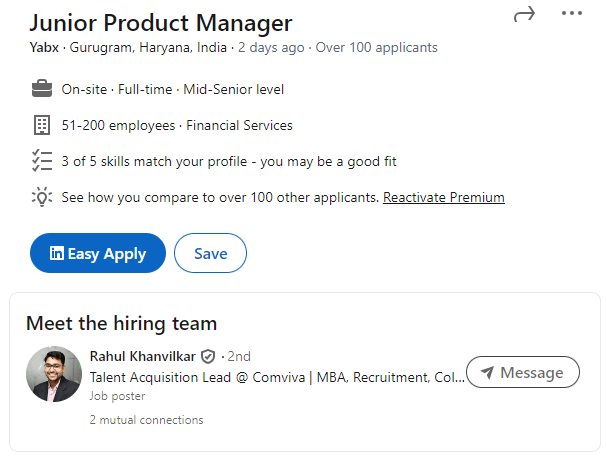
Hi Rahul,
My name is <YOUR_NAME> and I am currently a final year student at <YOUR_COLLEGE>. I happened to see that there is an opening at <COMPANY_NAME> for the role of a Junior Product Manager. I am actively learning Product Management and aspire to pursue a career as a PM and I think <COMPANY_NAME> will give me a jump start to my career. I am knowledgeable about <LIST_JD_KEYWORDS> and I fit the role very well.
I would really appreciate if you could give me a chance to exhibit my skills through an interview.
Thank-you and hoping to hear back soon.
<YOUR_NAME>
Hi Rahul,
My name is <YOUR_NAME> and I am a recent graduate from <COLLEGE_NAME>. I am actively looking out for product roles and I happened to stumble upon a job listing from your firm here on LinkedIn. I believe my skills match the skillset mentioned in the JD and hence I believe I am the right person for the job.
I am sending my resume along with this message and I hope we can have a chat soon.
Thanks!
While talking to recruiters you must be concise and to the point. Recruiters don’t really know what the skillsets really mean. Managers give them certain keywords (eg. Product Sense, PRD, etc) and they filter resumes which have these keywords. If you go on elaborating each and every point chances are that they are gonna skip your message.
On the other hand when you send a message to a Senior Product Manager or a Group Product Manager you can elaborate on what you are really passionate about and why the role feels enticing to you. They will understand it because it is their lingo.
An example message to a Senior Product person would go something like
Hi <NAME>,
My name is <YOUR_NAME> and I have recently graduated from <COLLEGE_NAME>. I am currently looking out for product roles which are geared towards growth. I have researched extensively on growth product management and I think my passion revolves around building this expertise. I have personally grown my brand online on Twitter (X) and LinkedIn and I currently have more than 10k followers on each platform.
I think by joining your organization I can learn the ropes of the trade faster. All I need is good mentorship and guidance.
Looking forward to hear from you.
Thank-you.
Getting into Product Management as a Software Engineer is tough. I am saying it cause I have experienced it. There would be many questions that would be flung your way.
You don’t need to necessarily need to create a Product Portfolio like a newbie, however you do need to make sure that you are ready with a modified resume. Say you have worked as a software engineer for 2 years. Now all the work you have done will be listed down on your resume but it would look like a software engineer’s resume. In fact when I first started out sending out resumes for a product role I would get calls from recruiters for an SDE role. You must include words and terms which sound “Productish”. If your current organization is product based and it has a product role, try to do an internal transition. Trying to convince recruiters is gonna be one hell of a job.
As a software engineer trying to transition to product you must aim for APM and PM roles. APM roles require a year of experience and are easier to come by. PM roles are usually reserved for folks who have decent enough experience in the industry. As a software engineer you can also venture head on into niche PM roles like PM (API) or PM (AI). PM for AI products pay really well and are suitable for engineers.
There’s another one called Technical Product Manager – transitioning to this role would be much easier as an engineer cause you can justify the expertise you have to the recruiter.
While reaching out to recruiters you must acknowledge the fact that you are someone who is planning a transition into Product from software engineering. This is important, else they might sideline you thinking that you have applied for a wrong position. Happened twice to me.
You can tweak messages when you reach out to recruiters/employees as follows
Hi Rahul,
My name is <YOUR_NAME> and I am currently working as a software engineer at <FIRM_NAME> . I happened to see that there is an opening at <TARGET_COMPANY> for the role of an Associate Product Manager. I am actively applying for Product roles and aspire to pursue a career as a PM. I am trying to transition from software to product since I believe my skills align towards product management.I would really appreciate if you could give me a chance to exhibit my skills through an interview.
Thank-you and hoping to hear back soon.
<YOUR_NAME>
If you send this to 50 recruiters, chances are that at least 2/3 might respond back positively. The response could be higher depending on your profile.
It would be a slow process but eventually of all the stones thrown in the dark, one will definitely hit and that’s the one you need to focus on aggressively.
The messages that we are talking about are outbound messages. Messages which were sent by you to the recipient where the recipient was not anticipating a message. Now there is another category where employees or recruiters are actively looking out for candidates through LinkedIn posts like the one below.
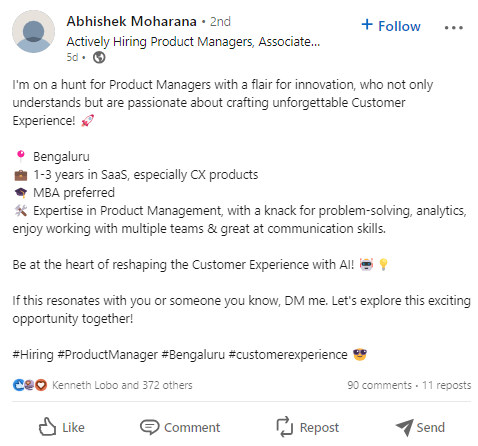
Both employees and Influencers do such postings. Employees probably do it for referral bonus and influencers for following. You can follow them to get updates, but there’s a better way. Instead of following them and flooding your feed with junk you can follow ‘Hashtags’ on LinkedIn.
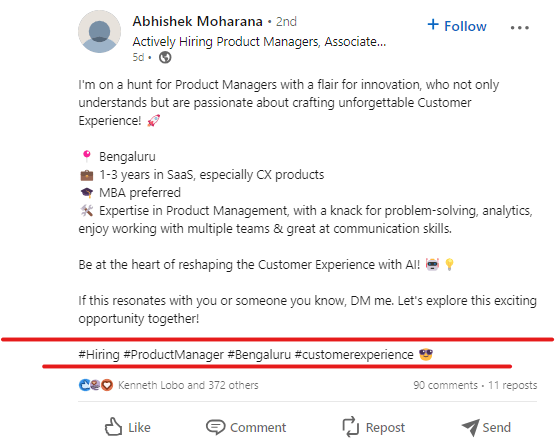
After every such post you can see hashtags like “hiring”, “ProductManagement”, “ProductJobs” etc. You can start following these posts to get that on top of your LikedIn feed.
To do that simply click on the hashtag and click on the follow button:
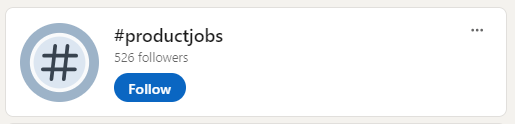
You will also get alerts if you are using the LinkedIn app if a posts pops up with a hashtag you are following.
That concludes #3 & #4.
Product PortfolioApplying onlineReaching out to recruitersLeveraging connections/ referrals
A lot many times you will not receive any update on a role for days on end. In all probability they have lost your application in the haystack. Remember, the goal is to get your resume in front of the decision maker. If your LinkedIn funnel is not working you must resort to other alternatives. Go to the company’s job page and apply there – not many use this funnel.
Apart from Job Portals one other place you can find genuine Job Openings is Twitter. Every time I have DMed a person on LinkedIn regarding a Job Opportunity I have heard back from them. This is probably because people are flooded with DMs on Twitter. Another Option you can try is Weekday . Weekday will scan your LinkedIn connections and if their organization is hiring for a product role then you can message them for a referral. How cool is that.
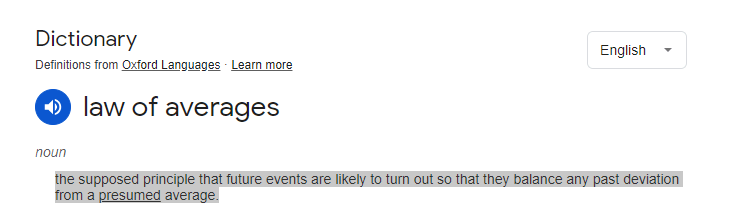
I have shared all the tools and techniques I have used to Job hunt. Remember the golden rule. Always apply in bulk. Keep a target of applying to at least 25 Jobs a day. Follow the law of averages.
If you have questions you can leave a comment and I will get back to you at my earliest.
Adios.
 Geo's Blog
Leave a comment